
东邪西毒 I Want to Infect You With History: Boedi Widjaja holds out a spray can beside a moving microscope image of a cell nucleus

东邪西毒 I Want to Infect You With History

I Want to Infect You With History, photograph 1

Multimodal installation with three-channel video essay, synthetic DNA and mist. Premiered at ShanghART West Bund Central, Shanghai (2025), and presented at NTU Museum, Singapore (2026). Installation views: NTU Museum, Singapore, 2026, unless otherwise noted.

I Want to Infect You With History, photograph 2

Suppressed histories can survive in bodies

The body carries what institutions are unable or unwilling to preserve. Spoken stories, displaced languages and inherited gestures keep fragments of the past alive, sometimes opaque even to those who carry them.

Drawing on research into epigenetics, Boedi Widjaja enters a speculative dialogue with DX|XD, an imaginary living cell, asking what a body might carry beyond conscious memory. His family’s experience as Chinese Indonesians meets a writer’s stories kept alive in prison, and landscapes marked by Cold War politics.

In the video essay, family testimony is heard alongside a poem shaped by the artist’s cultural inheritances. Encoded into synthetic DNA and dispersed as mist, the poem gives this act of translation a material form. History passes through the body and returns to the world changed, sometimes beyond recognition.

I Want to Infect You With History, photograph 3I Want to Infect You With History, photograph 4

“There really was no choice”

—Boedi’s father

Boedi’s parents recall how restrictions on trade and pressure to choose a nationality shaped their families’ lives in Indonesia. Political belonging entered the household through the need to earn a living, remain in a place and secure a future for their children.

Carried in breath

The Indonesian writer Pramoedya Ananta Toer was held as a political prisoner on Buru Island. Denied the means to write, he told stories aloud to fellow prisoners, who listened and remembered. Boedi returns to this episode to ask how stories survive when their means of inscription are taken away.

Ninth Tongue :: 九异, Boedi Widjaja’s translation key: the twenty Javanese Hanacaraka letters mapped to twenty amino acids and their DNA codons, from 南洋 Nanyang to Nusantara

Ninth Tongue :: 九异, Boedi’s translation key. Its two ends name the region it moves between: 南洋 Nanyang, the Chinese name for Southeast Asia, and Nusantara, the Indonesian name for the archipelago.

A poem takes body

Boedi’s four-line poem carries several cultural geographies in its English and Indonesian words. “Rivers and Lakes” recalls 江湖 jianghu, the world of wandering swordsmen he met through wuxia films. “Tanah dan Air” splits tanah air, the Indonesian word for homeland, into its parts: land and water. “Land and Water” echoes the Chinese expression 水土不服 shui tu bu fu, a body unable to acclimatise to another place. “Sungai Sejarah”, river of history, draws these crossings into a single current.

To give these words molecular form, Boedi devised a translation key, Ninth Tongue, shaped by his multilingual life. Their sounds pass through the Javanese Hanacaraka script, whose twenty letters he maps onto twenty amino acids, and then into DNA codons. With geneticist Eric Yap of the Institute for Digital Molecular Analytics and Science, he made the encoded poem as synthetic DNA. Suspended in water, the poem can now be dispersed as mist.

Rivers and Lakes

Tanah dan Air

Land and Water

Sungai Sejarah

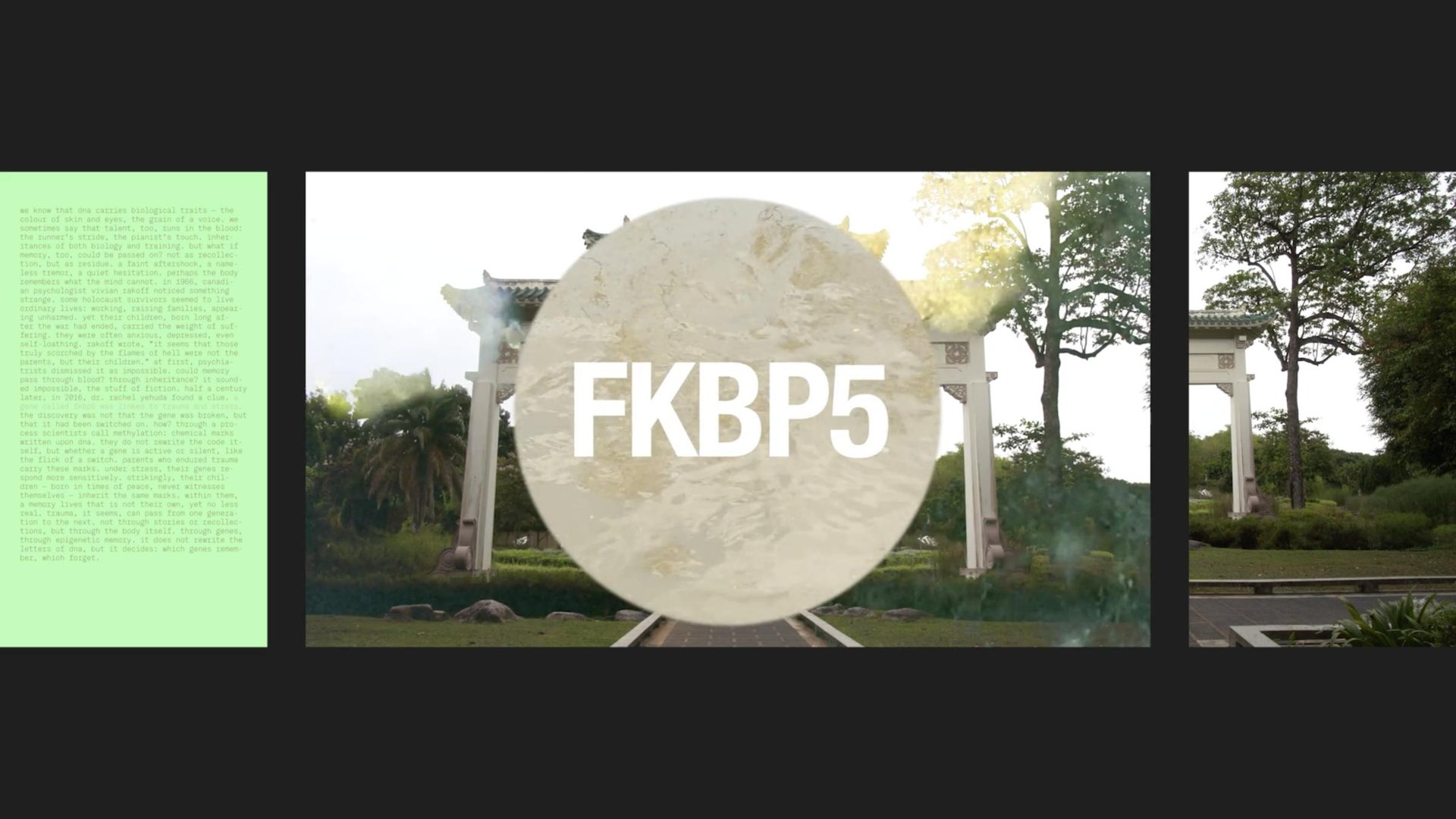
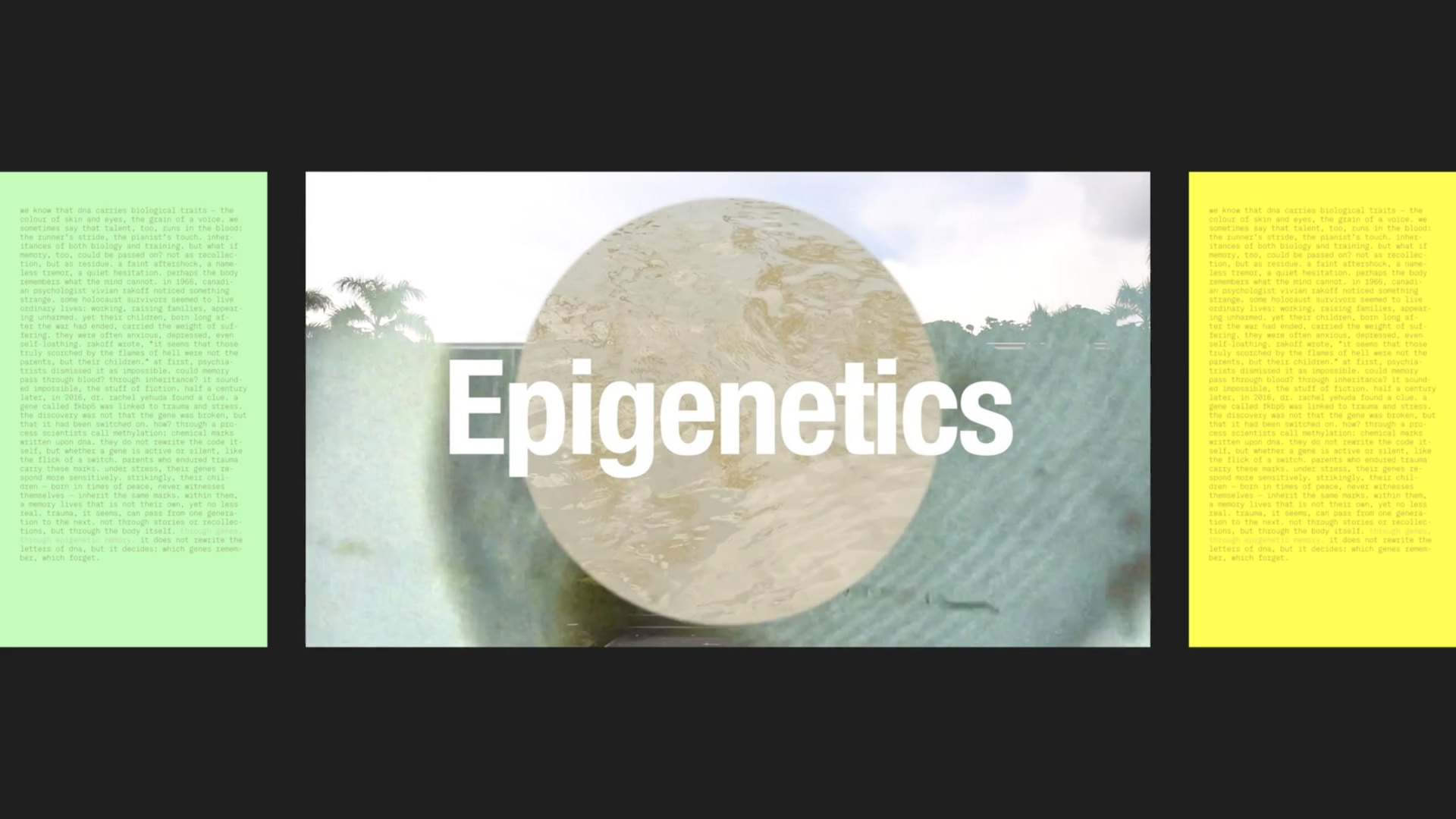
Nanyang University arch, 1955, in the three-channel workChinese Heritage Centre, NTU, in the three-channel workMist and cell overlay at the Nanyang archFKBP5 over the Nanyang archEpigenetics over the landscape

A landscape carrying history

Filmed around Nanyang Lake, Yunnan Garden and the Chinese Heritage Centre at Nanyang Technological University in Singapore, the work moves through the former grounds of Nanyang University, where Chinese diasporic aspirations met the pressures of Cold War politics and nation-building. Boedi crosses this landscape dispersing his DNA-encoded poem as mist. A personal inscription meets a place already shaped by migration, language and contested belonging, suggesting that bodies can also act on the histories held in a site.

The DNA-encoded poem, suspended in water, released into the air as mist. 东邪西毒 I Want to Infect You With History, 2025. Documentation of the mist installation, ShanghART West Bund Central, Shanghai, 2025, and NTU Museum, Singapore, 2026.

The poem passes to the audience

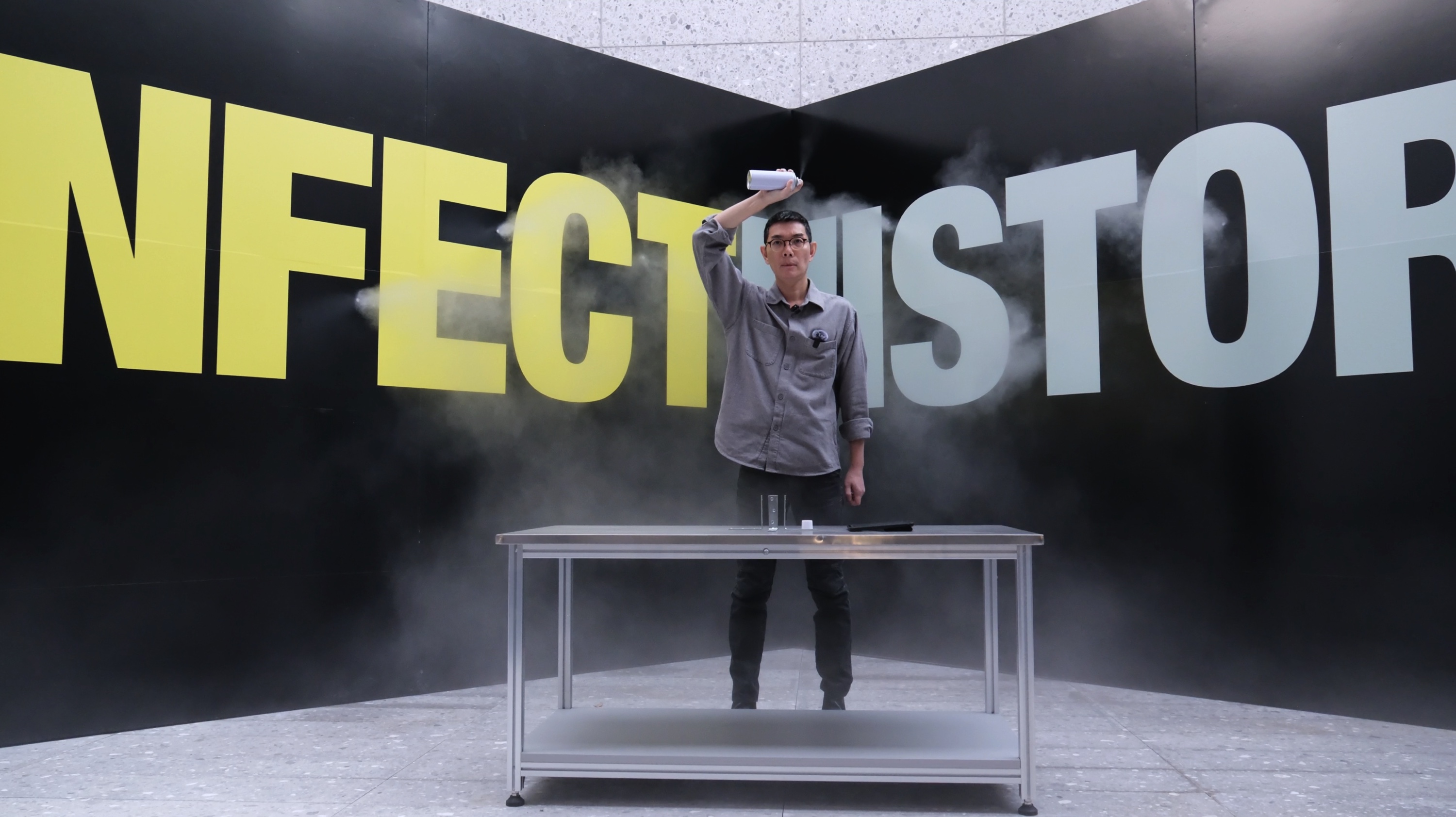
The work braids testimony, gesture and poetry, and then hands the poem to the audience. Visitors are invited to “self-infect”, spraying themselves with synthetic DNA that encodes the poem, which blurs the line between biological and cultural inheritance. They can receive it or refuse it. How might we carry inherited histories without reproducing their violence, and let them change through our encounters with others?

I Want to Infect You With History, photograph 9I Want to Infect You With History, photograph 10

Every 15 minutes, the installation wall releases the DNA-encoded poem into the air as mist. 东邪西毒 I Want to Infect You With History, 2025. Installation view, ShanghART West Bund Central, Shanghai, 2025.

Boedi sprays the DNA-encoded poem over himself, the gesture visitors are invited to repeat. Path. 16, 东邪西毒 I Want to Infect You With History, 2025. Performance-lecture, ShanghART West Bund Central, Shanghai, 14 November 2025.

I Want to Infect You With History, photograph 5
I Want to Infect You With History, photograph 6
I Want to Infect You With History, photograph 7

Artwork details

Title
东邪西毒 I Want to Infect You With History
Artist
Boedi Widjaja
Year
2025
Medium and materials
Multimodal installation comprising three-channel video essay, synthetic DNA, text art, misting system and aerosol cans.
Duration
31 min 26 sec
Dimensions
Variable
Processes and tools
Poetry translated through Ninth Tongue, a custom key linking sound, Javanese Hanacaraka script, amino acids and DNA codons; DNA synthesis; recorded family testimony; filmed performance; DNA suspended in water and dispersed as mist; audience “self-infection” with aerosol cans.
Presentations
Rivers and Lakes Redux, ShanghART West Bund Central, Shanghai, 14 November 2025 – 31 January 2026; On the cusp, NTU Museum, Singapore, 21 January – 2 April 2026.
Origins
Developed from Path. 16, 东邪西毒 I Want to Infect You With History, a performance-lecture first presented at Fotografiska Shanghai on 2 August 2025 by MACA Art Center, as part of Vortex, curated by Jin Feng.
Support
National Arts Council (Singapore) Creation Grant; Institute for Digital Molecular Analytics and Science (IDMxS); NTU Museum
Special thanks
Guo Guoerma, Lorenz Helbling, Jin Feng, Peggy Leong, Rong Li, Lian Zixuan, Liu Shuo, Lu Xiaohui, Cynthia Delaney Suwito, Wee Soon Keong, Wu Junyi, Xue Yuzhu, Eric Yap
Installation views
NTU Museum, Singapore, 2026. Photo: Third Street Studio. Courtesy of NTU Museum.ShanghART West Bund Central, Shanghai, 2025. Photo: Rong Li. Courtesy of ShanghART.
Further reading
On the cusp, exhibition catalogue with a conversation with the artist, curated by Lu Xiaohui. NTU Museum, January 2026 (PDF)Liu Shuo, essay on Rivers and Lakes Redux, ShanghART West Bund Central, Shanghai. ShanghART, January 2026. Translated by Chantel Shiah